
Collaborative Research Center 1333

Molecular Heterogeneous Catalysis
in Confined Geometries

B08 – Formic Acid Dehydrogenation in Confinement

Jun.-Prof. Dr. Deven Estes
University of Stuttgart
Misha Kumari
Misha Kumari
University of Stuttgart
Zeki Beydeda
Zeki Beydeda
University of Stuttgart

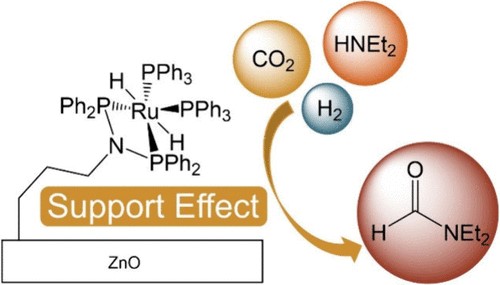
Efficient Dehydrogenation of High-Concentration Formic Acid Solutions using Confined Catalysts Studied by Advanced NMR Spectroscopy

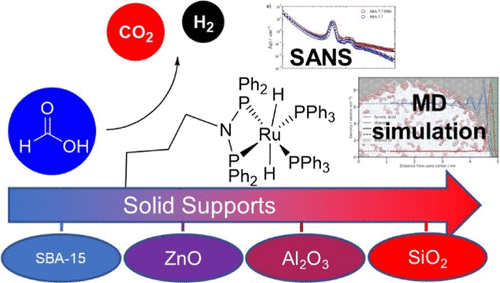
This project aims to improve the efficiency of formic acid dehydrogenation from highly concentrated solutions by confinement of catalysts in ordered mesoporous silica (OMS) materials. Confinement (which makes formic acid less acidic) prevents formic acid autoinhibition by decreasing the local pH in the pores, especially upon co-confinement with amines. This results in efficient binding of formate to the active metal complex, the binding of which will be measured by MAS NMR. Confinement will produce catalysts capable of efficiently dehydrogenating even pure formic acid.

Research focus in the second funding period (2022-2026):
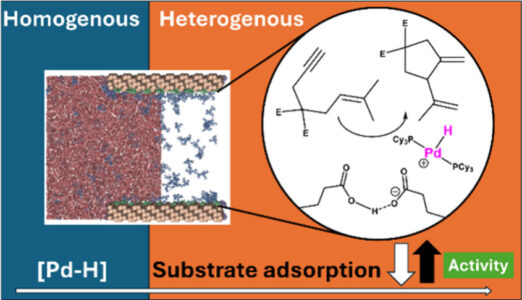
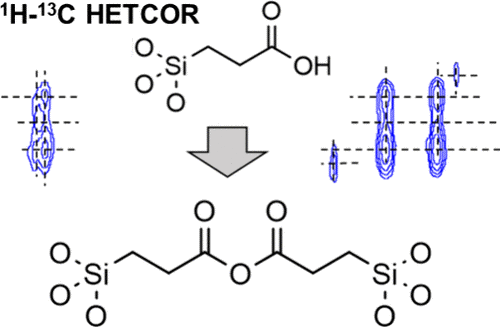
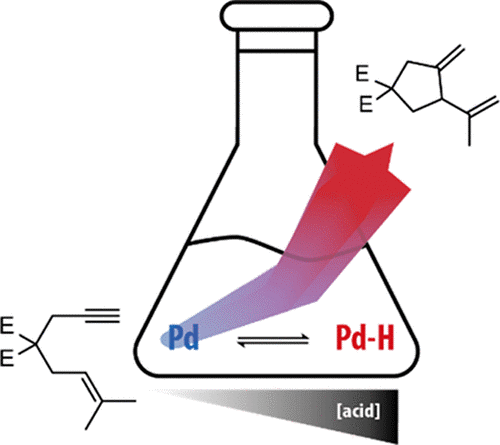
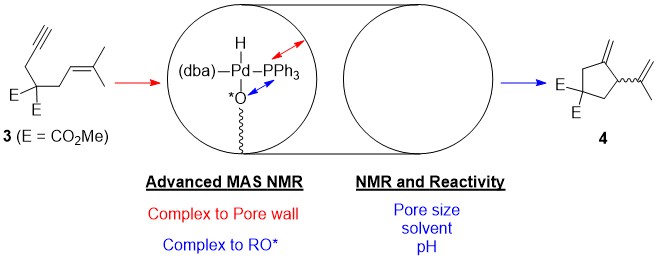
Probing confinement enhanced precatalyst association in Pd catalyzed enyne cycloisomerizations by advanced NMR spectroscopy: Palladium hydrides that catalyze enyne cycloisomerization reactions, typically formed in situ by reaction of weak Brönsted acids with Pd(0) complexes, are often only present in small equilibrium concentrations. The proportion of active catalyst as well as the catalytic selectivity can be, however, vastly increased through confinement due to the higher local concentration and interaction with the pore walls. In this project, we will use advanced MAS NMR techniques (such as HETCOR and REDOR) to observe the effect of confinement on the equilibrium of palladium hydride formation in pores and explain the effect on the catalytic activity and selectivity for enyne cycloisomerization.