


Collaborative Research Center 1333

Molecular Heterogeneous Catalysis
in Confined Geometries

Seed 6 – Synthesis of Metal–Organic/Covalent–Organic Hybrid Frameworks for Robust Catalyst Confinement in Precise Geometries

Jun.-Prof. Dr. Kenichi Endo
University of Stuttgart
Dr. Manpreet Singh
Dr. Manpreet Singh
University of Stuttgart
Akash Deshpande
Akash Deshpande
University of Stuttgart

Starting Date: May 08, 2025

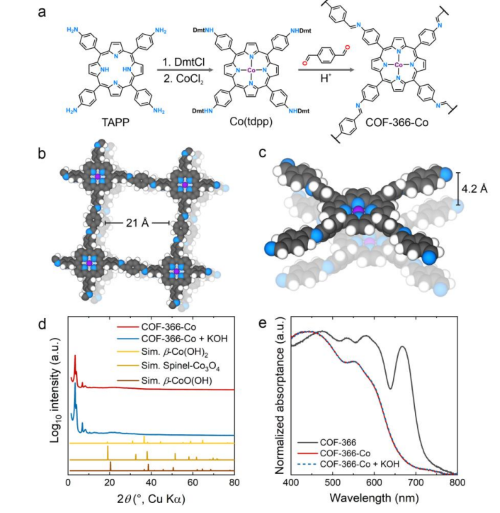
Metal–organic frameworks (MOFs) and covalent organic frameworks (COFs) are both promising materials for confining catalysts in unique geometries due to their high porosity and designability. Particularly, MOFs provide high crystallinity for achieving precise confinement geometries, while COFs offer high stability for securely confining catalysts. However, it is challenging to achieve both high crystallinity and stability simultaneously in either class of material. Therefore, in this project, we pursue the synthesis of a hybrid framework combining MOFs and COFs, referred to as MOCOFs. MOCOFs are prepared through a double-polymerization reaction, where amino-metalloporphyrin and dialdehyde molecules assemble via metal–amine coordination and imine condensation. Highly reversible metal–organic coordination ensures efficient crystallization, while the formation of covalent organic imine bonds supports structural stability. The resulting structures are determined by single-crystal X-ray diffraction, leveraging the high crystallinity, and provide scaffolds for the confinement of catalysts in robust and precise geometries.

Combining the advantages of MOFs and COFs, this project develops hybrid framework materials, so called MOCOFs.