
We are very happy to welcome within the CRC 1333 Colloquium Series:
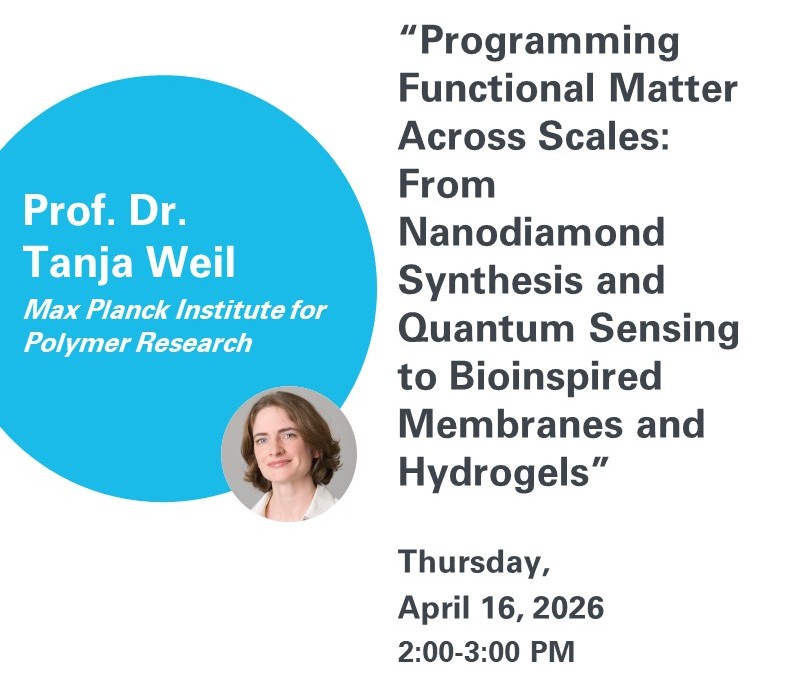
Thursday, April 16, 2026, 2:00-3:00 pm
Max Planck Institute for Polymer Research
Topic: “Programming Functional Matter Across Scales:
From Nanodiamond Synthesis and Quantum Sensing to Bioinspired Membranes and Hydrogels”
Professor Tanja Weil is an internationally recognized leader in the design of functional macromolecules and biohybrid materials with transformative applications in materials science and nanomedicine. Since 2017, she has served as Director, and previously as Managing Director, of the Max Planck Institute for Polymer Research (MPIP).
Her research bridges materials science and cell biology to design active biomaterials that dynamically interact with living systems. These materials enable precise control over cellular functions with applications in cancer therapy and neurodegenerative diseases. Trained as a chemist at the MPIP, she earned her doctorate from the Johannes Gutenberg University of Mainz, gained industrial experience at Merz Pharmaceuticals, and subsequently held faculty positions at the National University of Singapore and Ulm University, where she directed the Institute of Organic Chemistry III.
Professor Weil has received numerous honors, including the Otto Hahn Medal, an ERC Synergy Grant, and the Karl Ziegler Award. She serves on the Senate of the German Research Foundation, the Leibniz Association, and is an Associate Editor of JACS. She is a member of the Royal Society of Chemistry (RSC) and European Academy of Sciences (Académie Européenne des Sciences).
Abstract:
My research is inspired by the way nature builds matter across length scales, from molecular information and sequence-defined building blocks to supramolecular architectures and macroscopic materials with emergent function. Using short peptides as a model system, I will demonstrate how precise molecular interactions can encode ordered fibrils that evolve into macroscopic hydrogels with programmable mechanics and potential for bioprinting. I will further show how catechol and phenolic monomers can be transformed into bioinspired films and membranes whose interfacial chemistry enables selective transport, ion sieving, and robust functional interfaces. I will also present how molecular nanographene precursors open a route to the bottom-up synthesis of ultrasmall nanodiamonds with tailored defects, creating functional nanomaterials for nanoscale sensing in complex living systems. Together, these examples define a broader vision for my research: to program matter from the bottom up so that assembly, transport, sensing, and biological function emerge from molecular design with precision across scales.
The CRC cordially invites all who are interested to the lecture.